Why MMAP
Every other platform in this space was built to make school administration easier.
MMAP was built to make Montessori schools better.
The difference is philosophical before it is technical, and it shows up less in the feature list than in the things the platform will not do.
When a school leader says “we use MMAP,” it signals something about their school, not just about their software.
The night it started
A financial aid committee sat down one February evening to decide a year of tuition assistance. Eleven families, two hours.
One note read: father lost his job in November, starts a new role in March at lower pay. The head of school went home and stayed up rewriting the spreadsheet by hand.
That is the night I knew the spreadsheet had to go.
The questions
Five questions software for Montessori schools usually can’t answer.
Lesson tracking, billing, and parent communication are table stakes. Every platform does those things. These five are the questions that keep heads of school up at night, and the questions no other software in this space has tried to answer.
01
Is your staff growing?
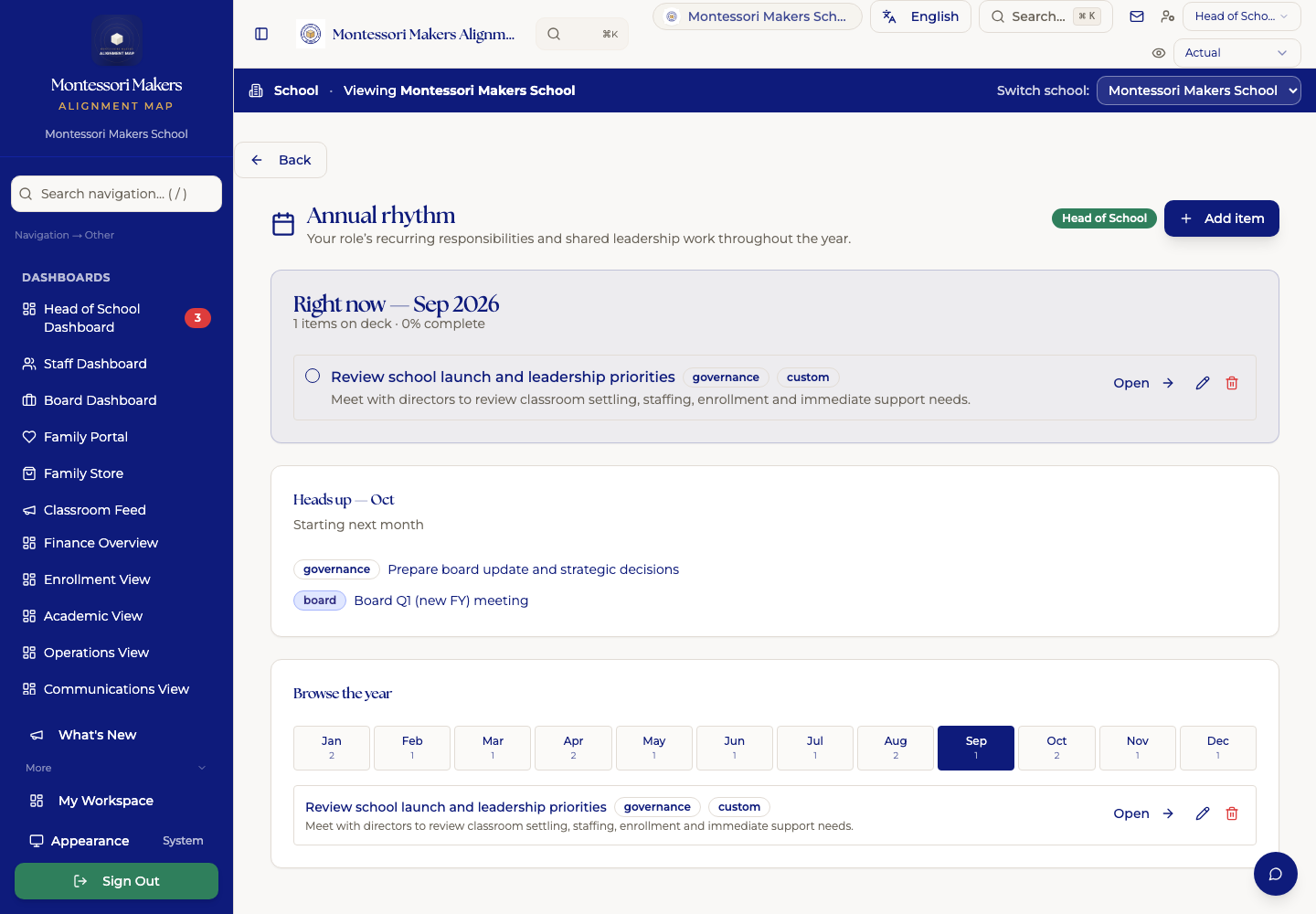
Coaching cycles, appraisals, role clarity, and an upward-feedback loop that helps your team actually develop, not just clock in.
02
Are your outcomes equitable?
Demographic dashboards, ABAR pathways, pulse surveys, and financial equity analysis built into the operating layer, not a workshop you book once a year.
03
Is your board making decisions from real data?
Board snapshots, governance reports, and strategic planning, alongside Leadership Meridian, which surfaces the open decisions and the risks a board ought to see before the meeting starts rather than in the minutes afterward.
04
Are you retaining your guides?
A staff culture and retention hub that names what is actually keeping people up at night, before the resignation letter lands in March.
05
Is your adolescent program actually Montessori?
Council, seminars, occupations, and trips, run with the structure adolescents need and the philosophy your school says it teaches. And because MMAP holds no student accounts, the students get their own platform.
What schools usually settle for
Three kinds of software Montessori schools usually settle for.
The market is fragmented into three camps. None of them was built to be the operating system of a Montessori school.
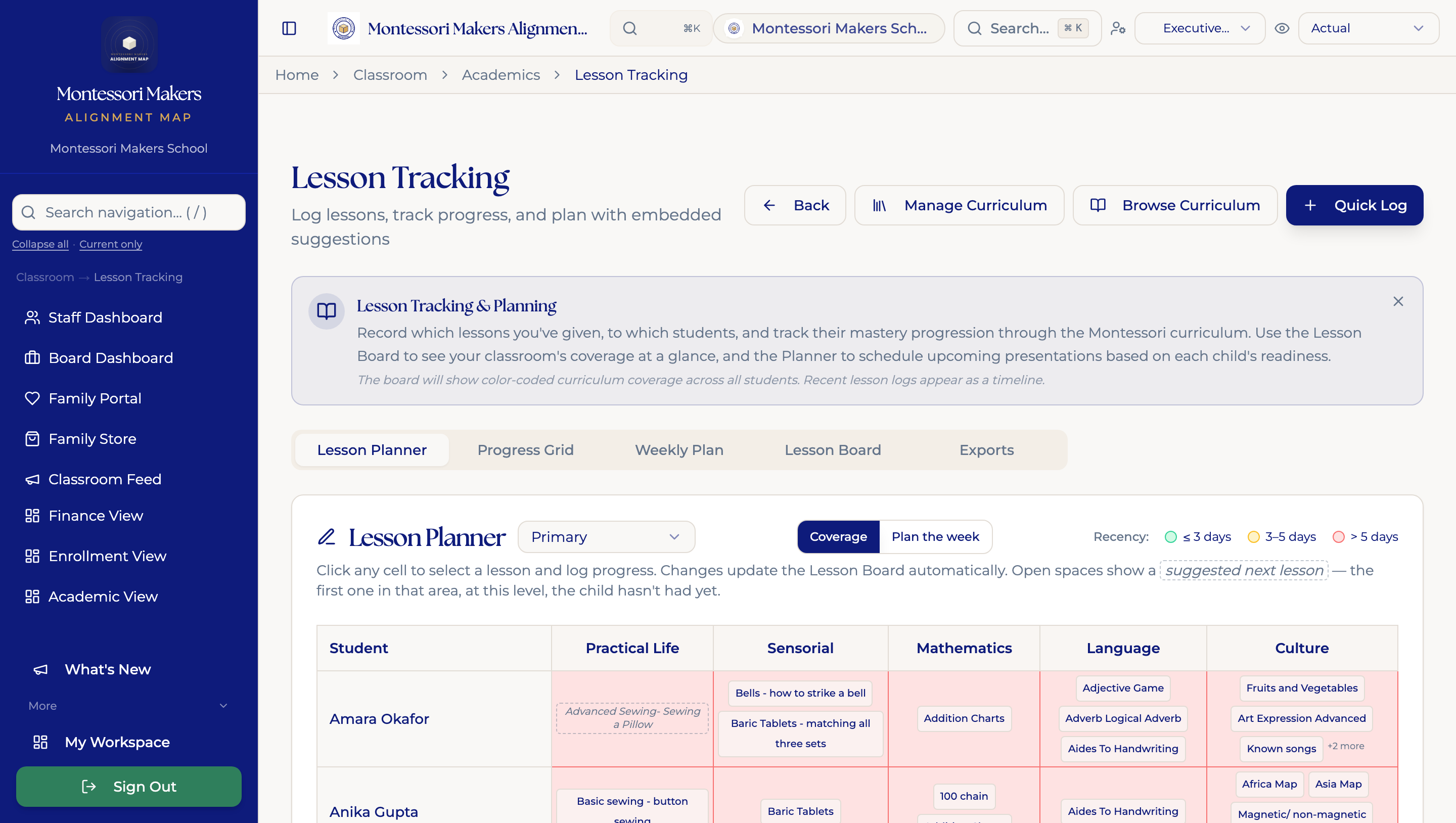
Classroom record-keeping tools
Strength
Genuinely strong at lesson tracking and observation records, because they were designed around what a guide does across a work cycle rather than what an office needs at month end.
Limit
Running a whole school on one means bolting two to four other products onto it, each with its own login, its own invoice, and its own idea of who a child is.
Childcare operations platforms
Strength
Strong at billing, attendance, and parent messaging, all of it built for daycare scale and priced for it.
Limit
Montessori arrives as a configuration option rather than a foundation, which you feel the first time you try to record a three-year cycle in a system that thinks in grade levels.
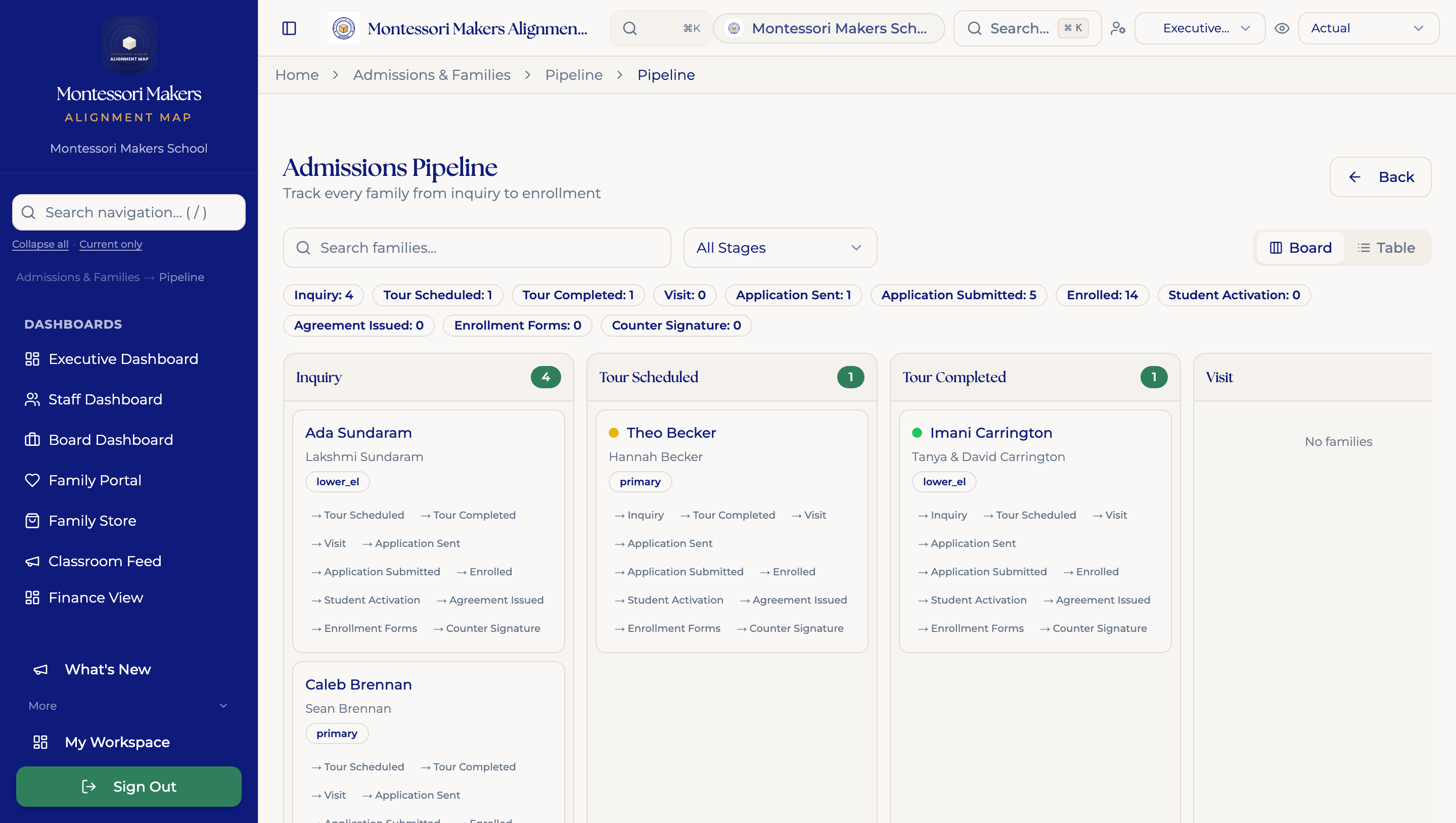
Admin and admissions tools
Strength
Strong at enrollment pipelines and tuition, and good at both, provided the work you need doing happens at the front office.
Limit
They stop at the office door, with nothing underneath for the classroom, for the staff, or for the equity questions a head of school is increasingly asked to answer.
The fourth option
MMAP is the only platform built to be the operating system of a Montessori school, from classroom to boardroom.
It was built by someone who has run one, and it arrives configured for your school by a dedicated Success Partner during onboarding rather than handed over as an empty account for you to work out on your own.
What’s included that nothing else is
Nine categories no other platform in this space is building.
We checked every major platform a Montessori school is currently buying. These nine categories appear on none of them, at any tier, at any price.
0% platform take on tuition payments
Equity & belonging infrastructure (ABAR)
Board governance & reports
Strategic planning hub
Leadership Meridian
Coaching cycles & appraisals
Staff culture & retention hub
Adolescent program suite
MatchHub job posting integration
If your school cares about any of these nine, MMAP is the only option built around them rather than retrofitted for them, which is the difference between something that was planned for and something that was patched in after enough customers asked.
A note on what stays human
Observation is not a feature.
Some software in this space writes a child’s progress report for their family, composes a parent message on a guide’s behalf, and turns a photo of a work cycle into a paragraph nobody at your school wrote.
MMAP does not.
The observation cycle, the conversation with a family, and the work of seeing a child are the prepared adult’s job. We built the platform to lift the friction off that work, not to do it for them.
What the platform handles
- Translating a family message across 17 languages, so multilingual families read the guide’s words, not a stripped-down summary.
- Compiling a quarter of observations into a printable progress report, in the format your school already uses. See a sample →
- Flagging when a child’s work pattern shifts, so the guide can take a closer look.
What stays with the adult
The seeing, the writing, and the conversation.
A photo, a lesson note, and a parent conversation are still human work. We will not put the platform between a guide and a child.
On billing
Billing, including the hard parts.
Split-family invoicing for separated and divorced parents is built and live, as are extended care fee rules and incidental charges, which between them account for most of the reasons a school ends up back in a spreadsheet halfway through the year.
If you are evaluating MMAP against a billing-first tool, ask us to walk you through the billing engine. We will show you.
Talk to us about your billing setup →See what an aligned school feels like.
Walk the platform, request a demo, or talk to Hannah about your school, whichever of those is the smallest useful next step from where you actually are right now.
Or read the philosophy behind the platform: Care of the Prepared Environment